Thursday, April 09, 2015

The quest for portable tripod

I never use those tripod specially geared for astronomy, except a few sets of wooden legs bundled with those equatorial mount.  I soon switched to camera tripods with tailor made adapters in order to maximize the portability.

Gitzo G1415 has been my heavy duty work horse.  It has been used with my APM Giro mount, and also Meade LXD55 and maybe a couple of other heavier duty mounts.  But then when I began to switch to absolute portable stuff, I go back to my Gitzo G106 for all the time.

Gitzo G106 is extremely small.  When the first time I met it in the shop, I could not fall into sleep that night and I go to the shop to buy it on the next day.  It supports my C5 well enough, even with a Nexstar SE mount.  It supports my GOTO Mark-X very well too!  It has been with my to solar eclipse trip, and also some traveling with my family.

However, it could be still quite big that I have to carry it with my hands.  It couldn't easily stow inside my backpack.  Until recently Velbon comes out with a mini white:


Crazy indeed, right?  I placed my regular sized mouse for comparison!  It's rated at 6kg capacity, just like my Gitzo G106, but it's way shorter and quite lighter!  The best thing is that, it's in the size of a camera lens and thus it could be placed inside a bag!

It's a bit cheaper than my G106 about twenty years ago.  The tripod head interface is 1/4" instead of 3/16" but then conversion screws are easy to find.

I couldn't wait to put it side by side with my G106 tonight.  I still believe the G106 is a bit stronger, but for absolute portability, this is going to be with me in the time to come!

--

I got home and couldn't wait to compare them side by side.  The tiny Gitzo G106 is a big boy in front of the Mini White!   Something like half of the height.


However, when fully extended (without the central column), they're pretty close in height.  The Gitzo has its traditional twist lock which is very effective and durable, however, it could be pretty slow to get all the legs fully extended, as you will need to do it one by one.   On the contrary, the Velbon twist lock action is very quick and easy, you can turn a leg until all the sections disengage, and then you can pull it all out, and turn on the opposite direction to get it fully locked.


However, such a locking mechanism has a price to pay, see the following picture.


There are quite a lot of plastic there, I doubt how long it would last.  The Gitzo, however, has brass locking rings and it's still kicking after like twenty years of services.

Anyway, the Mini White is still attractive, due to its size and weight.  To close this little preliminary impression article, I placed it side by side with my Canon 100-400mm... you see how small it is!


I won't hesitate to bring it out every time when I wanted to take photographs! 

Like a telescope, the one which got used the most is the best telescope.  This is going to be the best tripod as it's going to be used as much as it could be!

Tuesday, April 07, 2015

Partial lunar eclipse on 20150404

I am not trying to join the debate to see if it's a real total lunar eclipse or was it partial.  I'm impartial since I missed the moment of "totality" anyway.

I was away from my home city and I was observing in a remote rural area where there's a small but close enough hill to block all my view during the best moments.

This is what I got when I left that place before going into my hotel room:


I have a friend around who's a novice photographer, I borrowed her my lens and she was amazed to be able to take image of the partially eclipsed moon!


On the same night, I observed Jupiter with my Canon 100-400mm plus a 20mm eyepiece and a 2x barlows lens working at 3x as a relay lens so that I could use a star diagonal.

Monday, March 30, 2015

When you have more barlows lens than eyepieces

When you have more barlows lens than eyepieces, that means you're more a high resolution imaging person than a visual person.

I'm forced to be so since the sky was badly light polluted, high resolution imaging seems the only thing that could be done without much traveling.

Solar, lunar and planetary...

Wide field and deep sky imaging is more like a dream.

Sunday, March 29, 2015

20150328 Jupiter

The viewing angle was so bad, I couldn't use my C5.  Even if I used my Ranger, over 40% of the aperture was blocked, but anyway, just try it out!

With a 3x barlows, 2359 (GMT+8), the very last minute of the day:


The setup:-


Saturday, March 28, 2015

20150328 Sun

Prime focus mosaic of two frames, 1543 (GMT+8):-


Then we have 5x shots: 1242 (GMT+8):


1246 (GMT+8), AR2305:


1248 (GMT+8):


Finally, a mosaic of 2 frames at 2x taken at 1253 (GMT+8), a complex system of filaments:


Seeing 6/10, transparency 6/10.

4" refractor project: camera lens as telescope?

Someone said, everyone should have a 4" APO.  This is somewhat a magic number of aperture that thing remains portable and affordable, and it provides very nice visual and photographic potential.

To me, I want to remain light weight and absolute portable, and of course, I want to keep the cost down as well.

Several candidates from my mind:

1. Takahashi FC-100DC, f/7.4 at 2.8kg only
2. Borg 100ED, similar to the above
3. Canon EF 300mm f2.8L (USM), very light and fast too, but double the price of the above
4. Canon FD 300mm f2.8L, cheaper than all the above but have to modify myself
5. Chinese ED refractor, like Skyrover, even cheaper than the above one but far heavier

So, the best balance points are Canon EF 300mm f2.8L without USM (the problem is that Canon is not going to fix them in case of any problem) and the Canon FD 300mm f2.8L which got no problem about maintenance since it has nothing to repair basically.

For the simplest modification, check this out:

http://www.rogerrao.com/other/doc6.asp

After removing the rear mounting assembly which also contains the aperture control, the thread is M77 P0.75 so it's relatively easy to find suitable adapters.  And the best length from the M77 thread to the EF adapter seems to be 51mm according to the above site.

To get such an adapter with proper length, we have "大口径 中号调焦筒" from taobao, adapter are available from M62 to M42 featuring adjustable length from 28-62mm, very flexible indeed.

By connecting a M77 to M62 step down ring, the modification is done.  Other cheaper adjustable length adapter could be used, they're of smaller aperture.

I hope that it could be used as a small telescope and telephoto lens.  Time to search for those online reviews.  Tempting.

--

On the next morning, I searched around my cabinet.  The following adapters are useful:

First is a M42 to Canon mount adapter, should be useful if I want to couple the converted lens into a Canon EF lens, of course, manual focus only, no aperture control since it's removed.


Second is a M60 to 1.25" barrel adapter, useful to use the converted lens as a telescope.  1.25" is wide enough for a 300mm lens, 2" is probably over kill.  But who don't want wider field? 


So after the adjustable tube, I will need stepping ring with M60 male thread to connect an eyepiece adapter, and I will want M42 male thread to conect with a EF lens (mechanically only!)

Reverse macro rings could be used for EF lens coupling too.

And since 1.25" is smaller than 42mm, so it's safe to use a M42 adjustable tube with male thread as the output interface from the lens.

--

On choosing the adjustable tube, we need to consider the stepping rings.

M77 male from the lens --- adjustable tube -- M42 for EF lens OR M60 for eyepiece

M60 is not very common, so I will need one more ring...

--

Oh no.... simplifying the whole thing, I have an EF to 1.25" adapter!  So, once the lens is adapted as EF lens use, I could use an eyepiece without any other concern:

So the solution boils down to...

M77 male from the lens --- adjustable tube -- M42 for EF lens

So I will need stepping rings from M77 to M42, to connect to a both side M42 adjustable tube and then to the EF lens adapter!

The optical path length of a 1.25" diagonal is like 7-9cm, so even the shortest adapter (i.e. a M77 reverse macro adapter, male-male need to resolve too) won't work. ... need to try!

--

Phase One:

1. Buy a suitable FD 300mm 2.8, wait for a good deal
2. Buy a M42-M42 adjustable tube, and then output EF mount, to use eyepiece, use existing adapter

Phase Two: buy a reverse 77mm tube to couple with existing eyepiece adapter, to see if I can attached 1.25" eyepiece without barlows....

--

No no no ....

I found that I could simply do the following:

1. Buy a 77mm female to female adapter (possible two step rings, one step up and one step down again, 82mm seems a good bridge)

2. Buy a 77mm reverse macro ring

So the connection will be like this

M77 male thread from lens ->
M77 female thread from step up ring say to M82 ->
M82 step down ring output M77 female thread  -->
Reverse macro ring

So the above coupling will be shortest, and then I could use my existing pure mechanical macro extension tube (combinations) to give around 51mm and then the FD lens will be able to reach focus with EF camera.  

To use eyepiece, the extension tube could be removed to give more in-travel to accommodate a diagonal.

Very simple now, just a reverse macro ring plus two stepping rings!

I guess I don't need two M77 ring.... maybe stepping down a bit before going to a reverse adapter a good.

--

Final solution after looking at those stepping rings:-

1. EOS - M42 (female) adapter

2. 42mm male - 58mm female adapter

3. 58mm male - 77mm female adapter

Should be shortest, cheapest and thinnest with off the shelf components.

I believe that I will need to use a couple of macro extension tubes to create proper flange distance.  I really hope that it can reach focus without a barlows, then it will be a great rich field telescope too!  In that case, even better than a 300mm f2.8L IS USM!

--

Guess what, I got one off ebay at less than 1K USD.

Expected delivery on 7th of April... should proceed to order adapters from taobao.

Monday, March 23, 2015

20150323 Sun

It has been cloudy and extremely foggy for over a whole month!  Today is better, cloud keep moving around but we could do some solar imaging.

I've bought a new GSO 3x barlows... this is also its first light.

Two frame stitched together at prime focus, 1349 + 1350 (GMT+8):-


 The new GSO 3x barlows is good!  1351 (GMT+8), AR2305:-


1353 (GMT+8):-


With a 3x barlows, it's running at 1440mm, much less aggressive than the 2400mm with a 5x Powermate which will be reserved for better sky.

Seeing 3/10, transparency 3-5/10.

Friday, February 13, 2015

20150213 Sun

I got no time to shoot that extraordinary long filament... but it's not yet gone completely, so I caught the chance today.

The sky was full of scattering cloud.


Let's begin with 5x shots first:-


This monster prominence taken at 2400mm is bigger than Jupiter in size!  I've never seen such a big monster in the last ten years!

And then we have AR2282 in close up:-


Let's go to 2x:-


This is that long filament, it's not unexpected that part of it was now out of sight.  Notice that the filament extends rather far out to form a straight and tall prominence there, so we know how "thick" that filament actually is.  This is a two frames mosaic.


That bigger than Jupiter prominence at 2x:-


Finally, we go for prime focus shots:-


My younger daughter Almy was on sick leave today, so she had a view on all those features... she loves the view too!

20150212 Jupiter

The sky was not particularly good, but it's not easy to go out either.  I didn't take any planetary images for quite long and that's why I proceeded to a nearby playground to take some shots of the Jupiter.

Transparency was like 7/10, seeing 3/10.  I was going out with the Nexstar SE mount and C5 OTA in a big plastic bag on one hand, and the tripod plus accessories in a backpack.

First one was taken at prime focus.  The ASI refused to show anything, but on re-plugging and re-launching the software, it works finally.  It seems quite sensitive but I don't like the larger chip and high resolution especially with my Eee PC, I have to scroll around to see the whole chip or I've to shrink the image at 50% but it was no good for focusing.

The Eee PC is now having a new Chinese 9 cells battery and it really has much juice to run on... after an hour of imaging, it's still going very strong.


Not bad and no good either.  At least, I have much better images taken with my Ranger!  Note the three Jovian satellites around.

A close up with 2x barlows, showing no more detail than the above.


One can see the direction of the wind blowing here... a signature of poor seeing.

Monday, January 26, 2015

20150126 Moon

Very poor sky tonight, just for fun.

First shot C5 at prime focus:-


The rest with 2x barlows:-


Poor seeing and transparency.

20150126 Sun, also testing of Canon 100-400mm f4.5-5.6L (first generation) on H-alpha imaging

Thank God that I can get another Canon 100-400mm f4.5-5.6L finally.

I sold my first one before the release of the second generation, but then my sister bought my a new 70D so I deadly want to get a longer lens to fully utilize its focusing ability, so with some very nice offering, I got one finally.

Given it has the same 77mm thread with my Ranger, so why not try it out on Solar imaging too?  To use the BF10, I have a EOS 1.25" adapter, but to reach focus, I have to insert a 2x barlows before the BF10.  Conventional wisdom gives an estimate with 3x, so the first shot was done at around 300mm effective focal length with the Canon set at 100mm.


The image quality is far from satisfactory.  At first I would guess it's nice to take lower power full disc shot of the sun, but it's no good indeed.

Without much hope but just to complete the test, I set the Canon at 400mm, that means it's working at around 1200mm focal length.  To my big surprise, it's as sharp as my Ranger!  Maybe even better, I don't know.  But it really shines!  Very fine detail could be resolved with great contrast.


Okay, the test is done, so I switched back to my Ranger.  To get a full disc, I've to take two frames and stitch them together.  Transparency is no good today.


Then a close up AR2260 with a 5x Powermate, giving effectively 2400mm focal length.  The first one was obtained by K3CCD, my usual software of choice.


But then since now I've ASI and thus I have SharpCap installed, so why not trying it too with my Lumenera?  K3CCD was a bit troublesome, even I upgrade from Windows 8 to 8.1, it requires me to re-do the registration.  And the author Peter seems not responding after one whole week.  So, I switched for SharpCap.


With the software assisted focusing, the image seems sharper. 

Drop frame is further reduced after removing some more software from my Eee PC.

The sky seems alright until now, maybe I shall try out 2014BL86 tonight after dinner?

http://theskylive.com/2004bl86-tracker

Imaging should start at around 8:00pm or else it will be too low.

Sunday, January 18, 2015

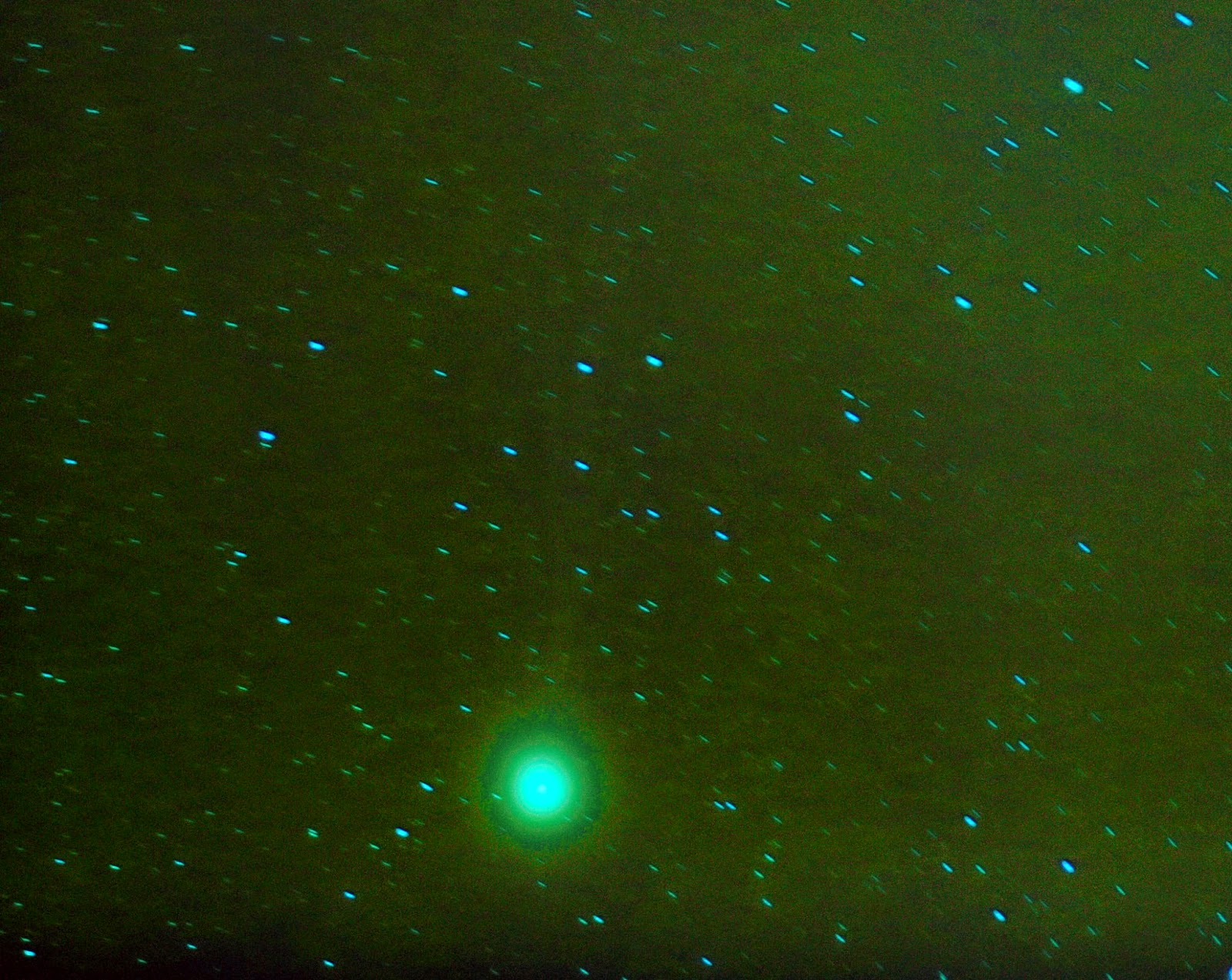
20150117 C2014/Q2 at Tai Mei Tuk


Fooling around DSS without much luck, I get back to Registax!  This is the resultant image.

Canon 200mm f2.8 wide open, ISO 3200, 30s exposure, 20 frames stacked.

The sky was foggy, I couldn't even see the Polaris.

We had some observation with some church buddies, one said it's like sputum... we had my Canon 10x30 IS for the observation.

--

Finally reprocessed in DSS, an inverted version to show the tail:-


Friday, January 16, 2015

20150116 Sun

While people are taking images of C2014/Q2, I couldn't afford the time to go to darker sky.  I am sick today but taking images of the sun is far easier.


AR2259 at 5x:-


Close up of the above prominences:-


Thursday, January 15, 2015

20150115 C2014/Q2 Again

So bad that I was trapped in the city...


ISO 1600, 15s exposure, 200mm at f2.8, 30 frames stacked... the sky might be too bright, and thus the faint tail remained buried by light pollution?


Wednesday, January 14, 2015

20150114 Sun

Given the transparency sky and a half day off, why not spend a few minutes to capture our sun?


Close up of AR2259, taken at 1512 (GMT+8), 5x powermate:-


Seeing 4/10, transparency 7/10.

Urban Comet Observation C2014/Q2 Lovejoy

I went back home at around 11:00p, and then cleared up the tasks of the kids... checking homework, technical support, etc... I went out at 11:30p!

I simply can't go too far, so I go to the playground where I used to jog.  Along the way, I checked the sky when there are trees blocking the close-by street lights.  M45 is naked eye visible, M42 of course.  But I could detect the comet by scanning around M45.

When I was about to arrive the playground, I settled for several minutes in another dark corner but then nothing was detected.  So I proceeded to the playground.

I found a chair, sat down.  I found some thin cloud but why not?  Armed with only a Canon 10x30 IS and my mobile phone as star chart, I found that I could use the bull eye, and M45 as guide posts... soon I located the comet without doubt.

It's big and diffused, bigger than M31 in darker (Hong Kong) sky... and remember this is from bright urban sky!  I guess that I was detecting a hint of the faint tail, too.

I am so happy... you know why I insisted to go out?  I worried that the weather forecast might betray me!  So, take any chance when you have, don't wait!

I'll surely go out again tomorrow night, with a small telescope plus a camera for sure!

Saturday, January 10, 2015

20150110 Indoor C2014/Q2

Just setup and shoot, no time to process yet.


--

The RAWs were so bad, so given up!

Thursday, January 08, 2015

GP style dovetail and quick release plate

The GP dovetail is undoubtedly the de facto standard for small to medium sized mount.

Yesterday night, I realized that its dimension is not far from another de facto standard for the quick release plate of many generic photographic ball head.


This kind of quick release plate comes in many different length, and more importantly, they're far cheaper! 

I've ordered two therefore, to be used with my Ranger and even other camera lens. 

Both my Nexstar SE mount and my GOTO Mark-X are using similar dovetail saddle!

Monday, January 05, 2015

Another launchpad

Last version

It's cloudy, so no imaging and time for DIY.  It's just an old mouse pad, not very thick but useful for low power.


I even made three 1.25" hole for holding my eyepieces and barlows.


Enough for low power visual observation.