Welcome to my astronomy blog. I dedicate myself to the simplest form of amateur astronomy which requires only portable equipments. I have small refractors, small binoculars, a small mount, and a small H-alpha solar filter.
Originally from a city where the people were proud of their light pollution, that is Hong Kong where I loved. Relocated to the UK since 2021.
Setup the S30 for mosaic around M81, M82, NGC3077 and NGC2076.
1:37 hr of signal acquired.
One with latest AI denoise another is raw stacked.
Trying out Jupiter with my 8" SCT, collimation was off after quite some time.
Some videos were taken at prime focus, I didn't take any after inserting the barlows. Collimation was pretty off.
First time trying out LuckyStackWorder, not bad at all.
Focusing with the short pier is no fun at all, centering the Jupiter was not too difficult with the bigger sensor of the 533mc but I don't think it's much fun. I am one more step closer to sell it, for visual observation a dobsonian might be better. I don't quite like planet imaging any more. Long focal length deep sky would require a better mount which I won't probably want. Time to downsize?
--
20260321 Followup
The collimation screws were too long, it should be 8mm but mine were 12mm, maybe that's why they couldn't hold the collimation well enough. Order has been placed to get 10mm collimation screws since I could get exactly 8mm. The new one has thinner thumb holder was shorter, the lens cap might be placed on after changing?
On checking my blog, I was considering adapting the NGF-CM to the ZWO EAF. It's well worth further exploration.
The first target will be M74. Straight out of the box:
I will try to test my 85mm refractor for Jupiter tonight. Seeing seems no good here, and maybe a refractor could bring more than a larger SCT?
(Maybe I shall also try unguided short exposure with the refractor too)
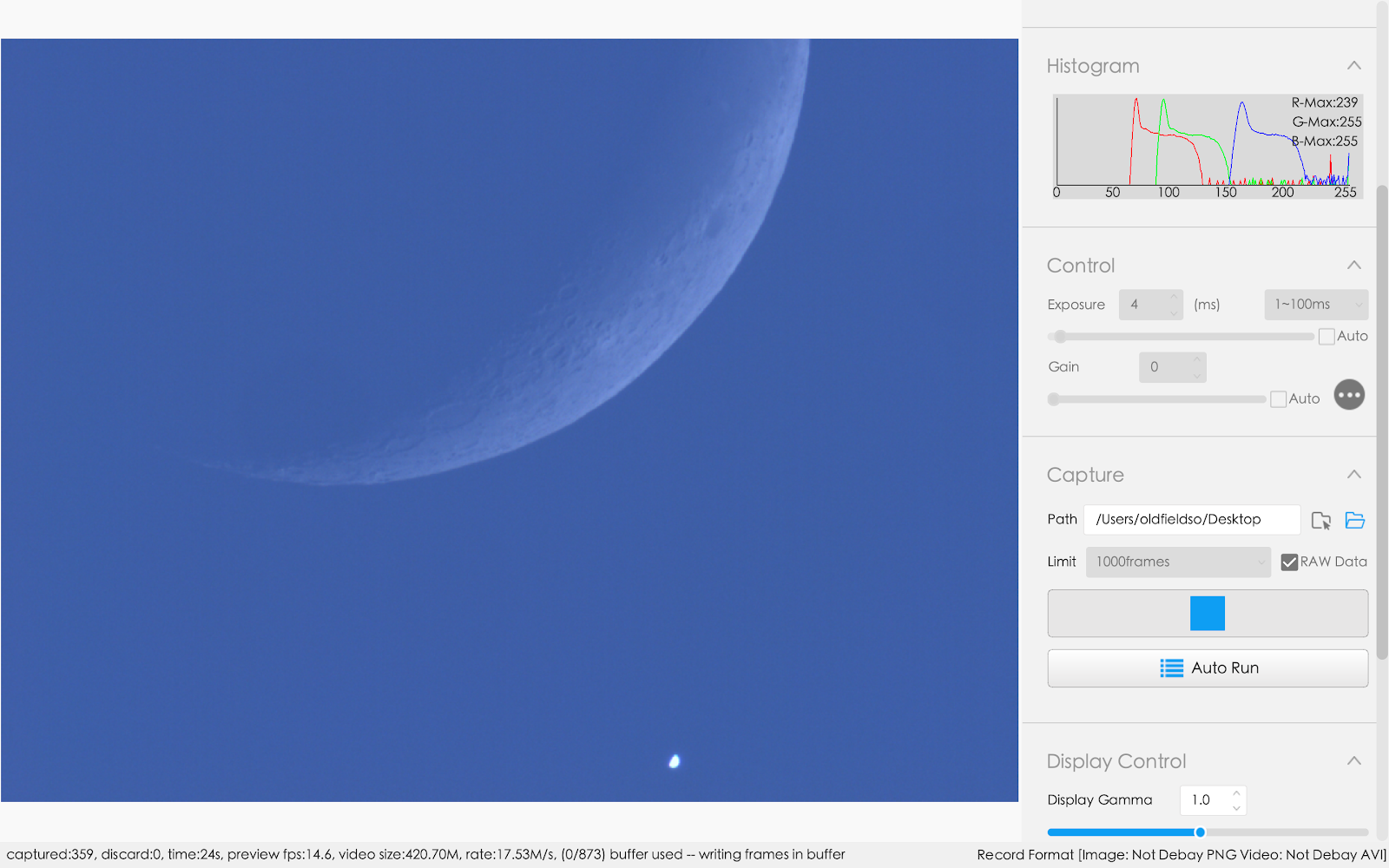
S30 Moon using planet video mode
While waiting for the Jupiter to come into view, I tried 30s exposure at f/6 (slower than S30) and for maybe around 15 minutes. Unguided. See how's the result. Much better sensor, cooled to -10 degree celcius too.
After maybe like 15 frames, it already looks way better than the S30 for more than an hour! This is a very good test. I should do some dark frames, patches maybe from condensation could be seen.
(pending)
M45 is my next testing target, 60s exposure when used, autoguiding enabled.
First time trying dark/flat/bias in live mode, quite easy to use.
(pending)
Trying ASIAir video mode, it feels good with 20fps at 360p cropped, 24 fps at 240 cropped. Good enough for a small refractor. 85mm refractor with 2x barlows:
I would say ASIAir mini should be good enough for planet imaging up to around a 4 inch refractor with quite respectable frame rate. Of course, nothing serious could be obtained with such a setup. The video mode GUI is pretty intuitive and easy to use, maybe even better than ASICap.
I pulled out my 85ED when I saw the Mars and the moon hanging outside my windows.
I looked at the Mars with my 4mm TMB, and then I turned to the moon.
Took a couple of images, and then I called my younger daughter Almy me. She enjoys the view through the eyepiece and she even took some afocal snapshots with her mobile phone.
All the images below were taken with my ASI 120mc, yes I was too lazy to switch back to the 120mm after imaging the Mars.
1554, (UT), 85ED with 5x Powermate Drizzle 1.5x, ASI 120mm.
It was amber rainstorm this morning, but it's quite clear tonight. Seeing very poor and I could see a shaky image even at very low power.
The Martian dust storm seems cleared up, maybe the best image taken this apparition for me.
I has been fine tuning my Nexstar mount, a circular wooden base was added for better balance, preventing tip over. The controller cable was made longer so that the shake from the cable won't induce vibration to the mount now. The base was still unstable, and I placed an eyepiece cover below to stop the vibration, since I've only four small pads below. Some more would be added shortly.
Since I got a 2" focuser for my Ranger, I always wanted to go for a 2" diagonal plus a wide field grenade level eyepiece. Formerly, I had owned an Antares 2" SCT diagonal and also later a Zhi-tong 2" diagonal, and they served me well, and my eyepiece was a 2" 40mm Pentax SMC XL which I loved so much! I sold it before I transformed my Ranger into 2". I always missed the wide field and the observation comfort of the Pentax SMC XL!
Recently, I got my 85ED and it features a 2.5" focuser. My Tele Vue 1.25" diagonal is aging after twenty years of service. So, it's time to update myself with a modern 99%+ dielectric diagonal, so why not go for a 2 incher? It's a ES carbon fibre model which I've written about it shortly before.
After about one week of usage, I'm confident about the brand. So, I took the plunge to buy a 30mm 82 degree eyepiece of the same brand:
It feels heavier than the Pentax SMC XL, a little bit bigger as well. It's very well made, despite it's made in China.
First of all, I tested it with my 85ED on terrestrial objects and it's color free. It is not as comfortable as the Pentax SMC XL but it's close. The eye-relief is decent, the eye cup is small but effective. I could see the whole gigantic 82 degrees field of view all at once, the feeling is immersing. With the Pentax SMC XL, the feeling is huge and wide, and this one, there is more space than you can view all at once. The higher magnification should be favorable. Remember, I had sold my Pentax SMC XL and so it is not a side-by-side comparison, but it's a comparison from my highly favorable memory of the Pentax. So, it could be unfair.
Switching to the sky, stars were pinpoint to about 80% of the whole field and the outer stars require re-focusing to become pinpoints, and thus it's field curvature. I don't know it's the 85ED or the eyepiece itself. But anyway, it's good enough for all purpose.
With the 85ED, it's at 17x having a 4.82 degree true field of view! It's just stunning!
With this eyepiece, re-balancing is a must! I took the above picture before the test.
I scanned around the little patch of sky from inside my home, and I found a strange "star", I soon realized that it must be Saturn. Plugging in my 20mm widescan eyepiece confirms that. Hey, why not take a snapshot of it?
1607 (UT+8), 85ED 5x Powermate, Drizzle 1.5x.
Poor seeing at 5/10, transparency 5/10. Saturn is a rare target for me, I want to try more this season when it's still in good position from inside my home.
My setup was changed a bit last night, I order two more short monopod extenders for my Nexstar mount, I used them to replace my camping table, which is not very stable after all.
It's now more stable, but I will want to make a wider base for it, to prevent it from tipping over. I will also want to make a longer cable for my Nexstar controller so that I won't introduce vibration to the setup when I need to touch the keys.
Mars Opposition could be observed for a period of time, say a week or even a whole month.
Therefore, the total lunar eclipse was the prime target earlier this morning, it's the longest total lunar eclipse for the century. I came home after working and slept nearly immediately to prepare myself to wake up for this event.
The sky was not promising, one word says it all: misty. When I woke up after less than two hour of sleep, it didn't improve a bit... luckily, the moon and the bright Mars were still visible through the mist or thin cloud.
Encouraged, I pulled out my 85ED and mounted it on my Nexstar mount, in the hope to capture some high power shots with my ASI 120mc.
Took two clips but none of them was stackable, so I posted the raw video as below. The exposure and gain were both very high, yielding very low frame rate:
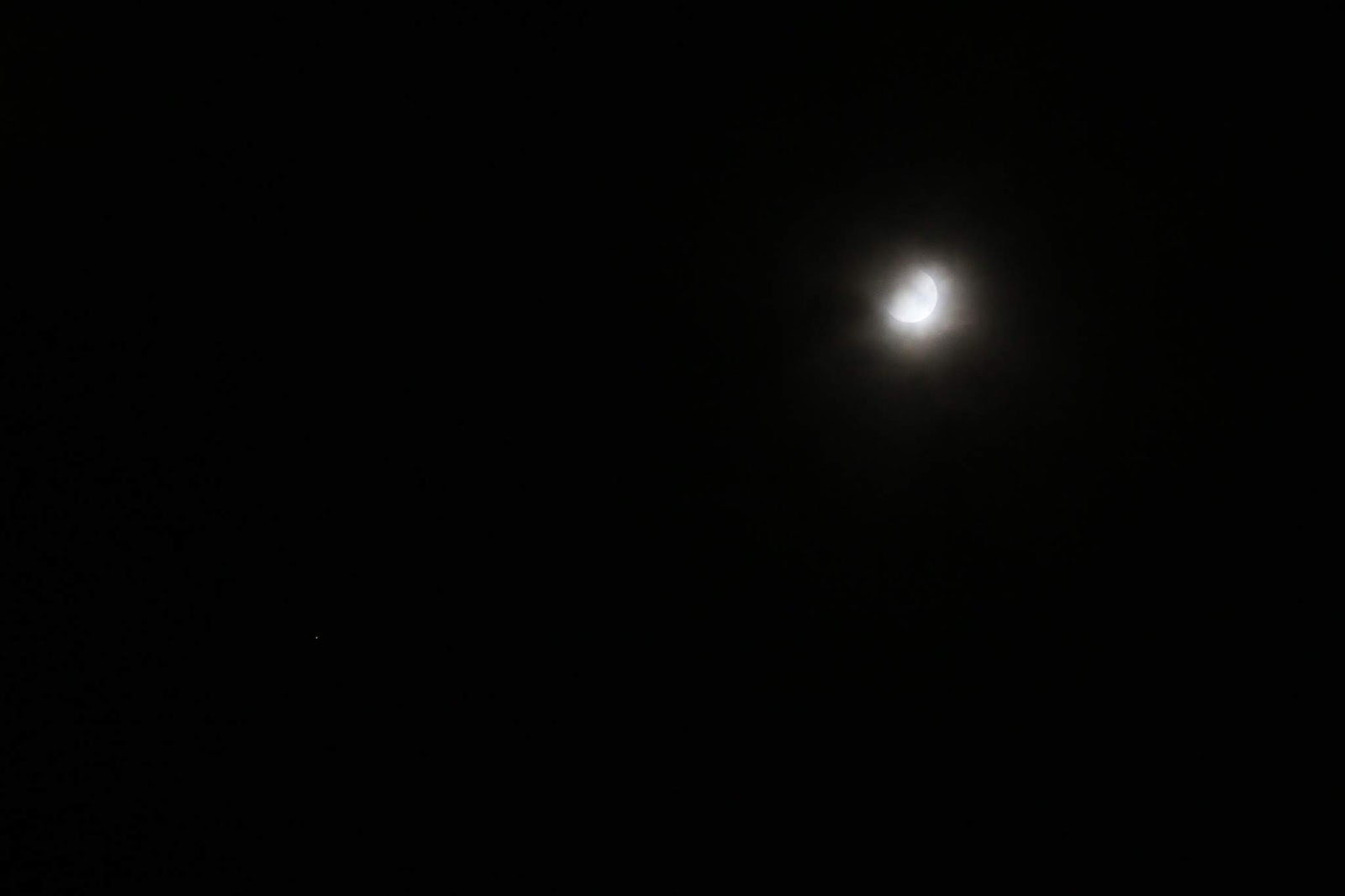
Since the mount was occupied, I took this with a Canon 100-400mm hand-held using spot metering, 0246 (GMT+8):
And then a wide field shot, 0248 (GMT+8):
Manual exposure was used to keep the exposure fast enough not to overexpose the lunar disc too much.
And then this one at 0318 (GMT+8):-
And a quick closer up 0323 (GMT+8), to show the red hue:-
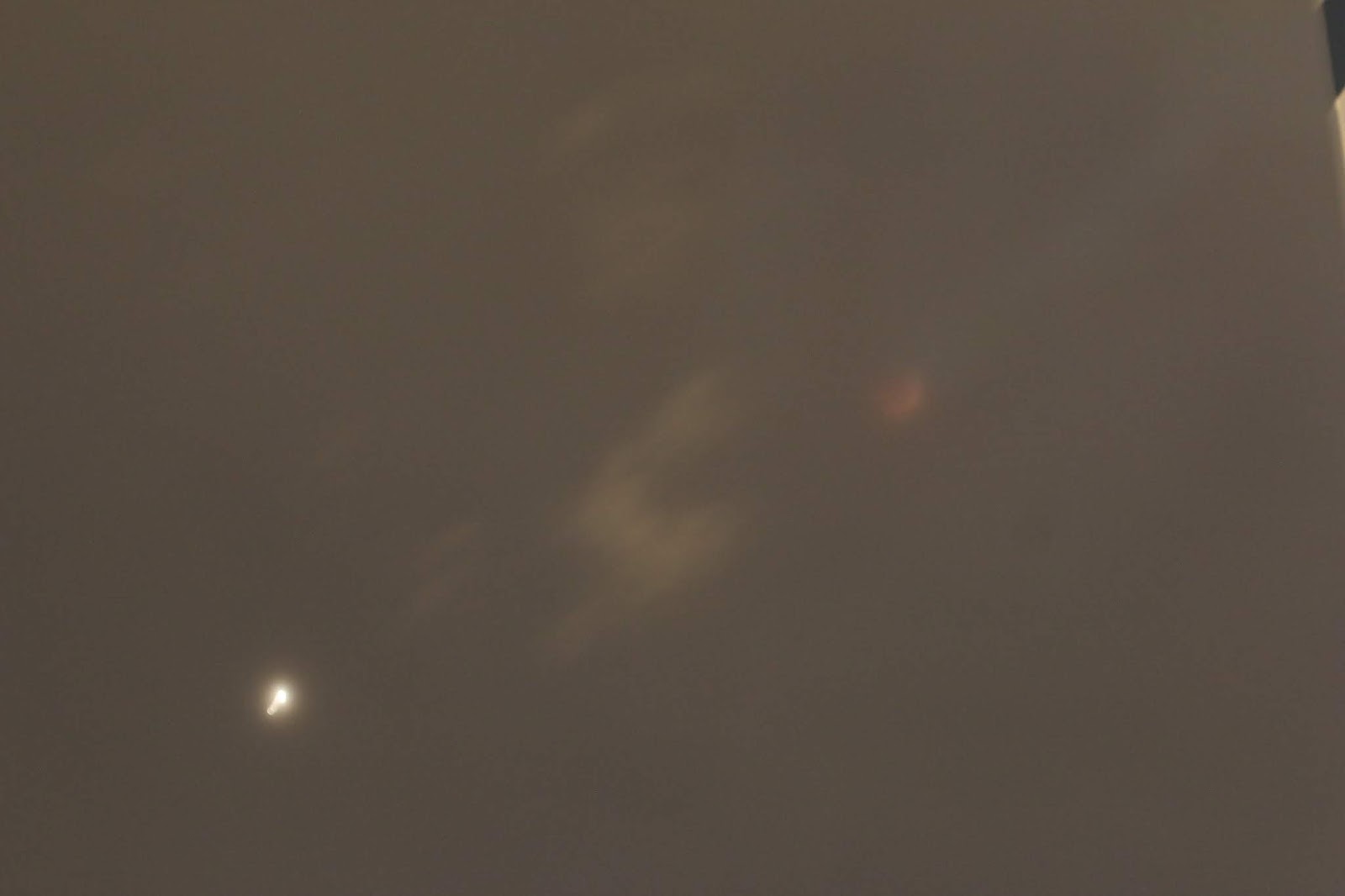
And then things got worse, I have to use GOTO to the moon! Can you see the moon in this shot? I am sure not! The shot below also told you how close the moon to a nearby new building.
But you know, when there's nothing, there's really nothing there! I pulled out my 10x30 and checked with my eyes, nothing. 5 seconds exposure? nothing.
When you were about the give up, I realized that I could just close the window and sit in an air conditioned room to wait, so why not? After some wait and hey... was it a cloud or what? no, it's the moon! taken at 0409 (GMT+8)
The Mars was way brighter than the moon by then, not unexpected, right?
04:22 (GMT+8), probably the best eclipse shot of the night, stars could be seen around the moon, clearest moment of the night. I could imagine such a totality would be wonderful under a dark cloudless night! But hey, we could only imagine as a Hong Kong observer!
04:25 (GMT+8), and the Canon 100-400mm got the mount now, I checked the EXIF and it was at 200mm, a zoom lens could be nice for this purpose, you could frame your shot the way you liked:-
And a shorter exposure one at 0426 (GMT+8):-
I tried to get a close up but it was shaky, since the cloud was getting thick resulting in longer exposure. The cloud window was closed.
Alright, time to sleep. Luckily, it was Saturday in the next morning so I could sleep longer to make up the observation time.
Finally, a few slash back shots:
First up were two mobile phone shots while going home, before the eclipse:
This shot with a historical building in the front, should be taken as layers and merged back, but I got no time to do so.
Equipment shots, of course, taken during cloud cover, just a record. The new ES diagonal is nice.
And finally, the Canon 100-400mm lens on the Nexstar:
Sorry that I (very rarely these years) bought new equipment these weeks, and still got some in transit, weather curse applied.
A short summary in Chinese: 香港天文,注定有雲 (Hong Kong astronomy, cloudy astronomy)
It's 20180712 already in terms of local time, but the title is in UT.
Other than the world cup, woke up for the first shot of Mars for this apparition... really dusty!
2102 (UT)
Manual focusing was used as the electric focuser is under revamp, it's still doable with some patience. 85mm ED with 5x Powermate, 1.5x Drizzle as usual.
My Asus Eee has been repaired several times, I've replaced its keyboard, hard drive, battery and even CPU/chipset fan. The transformer is dying so that I could use it either to charge up the battery or to operate the computer but not both, otherwise, the computer will reboot itself randomly. Worst yet, it is still running Windows XP and would be obsolete enough soon, for example, no more dropbox in the near future.
So I took the plunge to buy a new notebook, but I was on a budget. I want something light and small, despite I could use my Teclast tablet when I want absolute portability. Finally, I got a Acer Aspire ES 11 which features a bigger display, and it's lighter in weight and has better battery life. USB 3.0 port is available as well, but of course, it won't be much faster. This is a fact of life, you choose only two: cost, performance, portability.
I have installed everything there so that it would be my next work horse. ASI 120mm and 120mc drivers were installed, that megapixel monochrome camera too! No more dropped frame with the all the cameras. So nice!
I had virtually stopped planetary imaging after the shut down of my home@walnut observation point inside my home.
Tonight, I pulled out my C5 with the Nexstar mount to a nearby playground for planet imaging. While most people were jogging (I use to jog there too), I took a seat on the grass and started imaging.
I feel like an idiot since I spent long time just to center my targets enough for imaging. I still remember that I could do imaging with my C8 at f/50 but now I found a hard time using my C5 at f/20!
This is my mobile imaging station. There is a tiny Gitzo G106 below, and a small projector metal plate to support both my Nexstar and my 10" Teclast Windows 8.1 tablet with a keyboard. It won't be very stable as expected.
Transferring huge AVI files for imaging processing is slow. My first target was Jupiter but then the processing of Mars was faster.
1345 (UT), this is stacked without further processing basically.
1347 (UT), this one is aggressively processed but it does not help much, maybe even worse... anyway.
Both taken with my C5 with a Tele Vue 2x barlows. Without a IR blocker, the image is no good as expected.
Jupiter C5 at prime focus, 1308 (UT):-
With 2x barlows, 1319 (UT):-
Much worse than what I could do previously with a C5, I shall practise more.