Welcome to my astronomy blog. I dedicate myself to the simplest form of amateur astronomy which requires only portable equipments. I have small refractors, small binoculars, a small mount, and a small H-alpha solar filter.
Originally from a city where the people were proud of their light pollution, that is Hong Kong where I loved. Relocated to the UK since 2021.
This is the second adapter made for the NGF-CM, this is a 2" nosepiece to connect with my Meade 8" SCT as well as my 85mm refractor. It can be used with any telescope with a 2" focuser if it could provide enough focus travel. Since the NGF-CM is pretty low profile, so at least the above two will work without problem.
Pulling out my Meade SCT to test:
It's not yet dark, but observing the moon is no problem.
The collimation is dead-on this time, pushing to 250x with the SVBony 8-16mm at 8mm is great. I missed the view of the moon at such high power for long. Good thing is that, the SVBony is nearly parfocal with my Explore Scientific 30mm.
--
Setup my S30 at around 10:05, pointing at M92, a globular cluster:
Around 30 minutes of exposure, dedicated this short session to this target.
The first target will be M74. Straight out of the box:
I will try to test my 85mm refractor for Jupiter tonight. Seeing seems no good here, and maybe a refractor could bring more than a larger SCT?
(Maybe I shall also try unguided short exposure with the refractor too)
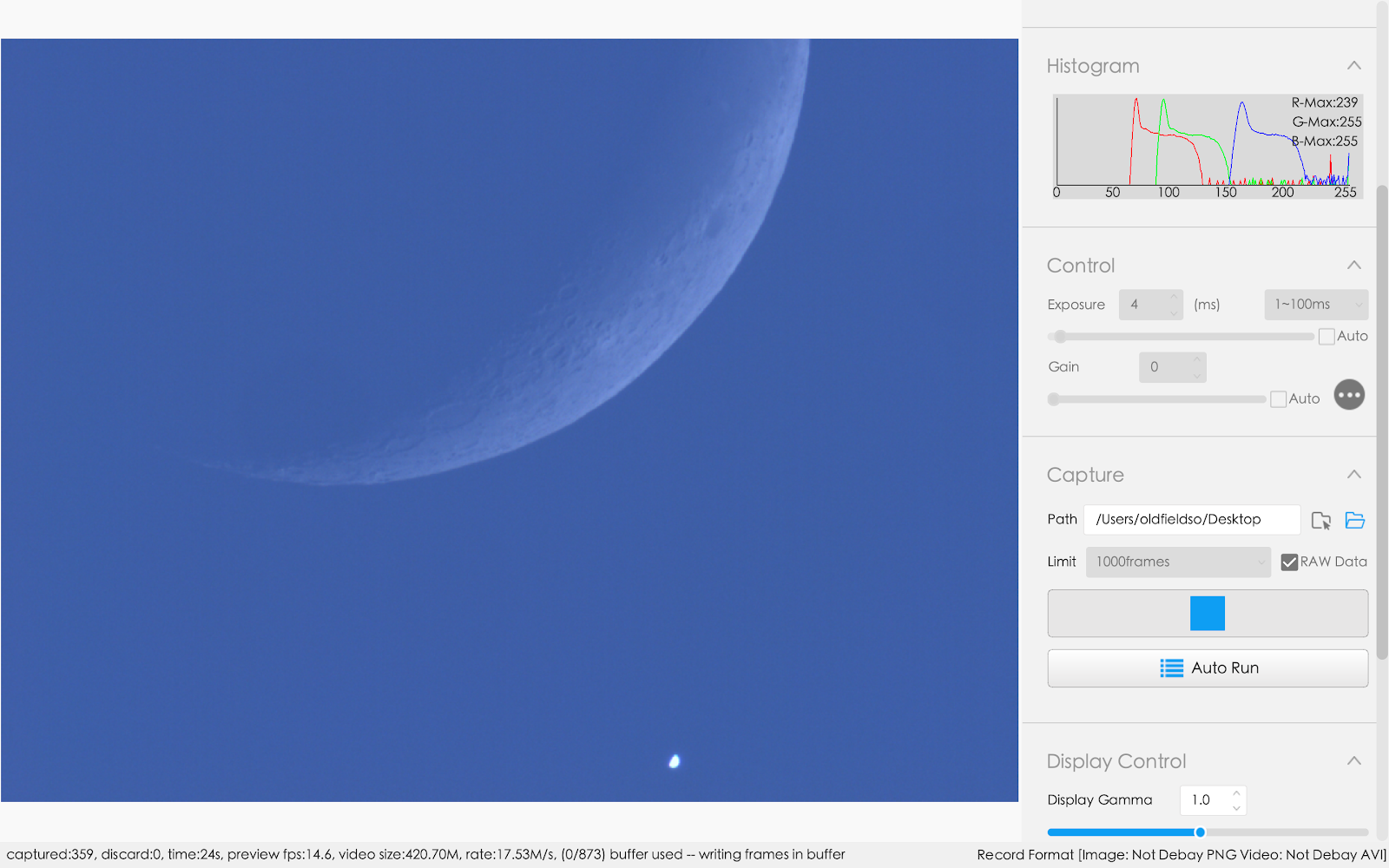
S30 Moon using planet video mode
While waiting for the Jupiter to come into view, I tried 30s exposure at f/6 (slower than S30) and for maybe around 15 minutes. Unguided. See how's the result. Much better sensor, cooled to -10 degree celcius too.
After maybe like 15 frames, it already looks way better than the S30 for more than an hour! This is a very good test. I should do some dark frames, patches maybe from condensation could be seen.
(pending)
M45 is my next testing target, 60s exposure when used, autoguiding enabled.
First time trying dark/flat/bias in live mode, quite easy to use.
(pending)
Trying ASIAir video mode, it feels good with 20fps at 360p cropped, 24 fps at 240 cropped. Good enough for a small refractor. 85mm refractor with 2x barlows:
I would say ASIAir mini should be good enough for planet imaging up to around a 4 inch refractor with quite respectable frame rate. Of course, nothing serious could be obtained with such a setup. The video mode GUI is pretty intuitive and easy to use, maybe even better than ASICap.
The new baby arrived, gonna test it despite the poor sky condition, I would say seeing 3/10 with transparency 5/10.
I am adjusting myself on the transparency rating, and if I were still in Hong Kong, I would say it's 6//10 and if I were to compare with the previous clear nights, I would say it's more like 3-4/10, even Orion was not too visible to the naked eyes.
With the strong tripod, the mount was steady enough for the Meade 8" SCT. Focusing was tricky anyway, the mirror shift worsen the problem further but that was doable with patience. Patience is cool weather came with a price, especially when you couldn't use the glove.
Anyway, here were the results. First up were prime focus shots on the moon, given the pixel size of 2.9um, the optimal sampling would be like f/14.5 so f/10 is a bit under sampled.
Next up was the Jupiter, I've to adjust my Rigel Quik Finder in order to point at the Jupiter properly, the flip mirror did help but still requires some effort. Adding a 2x barlows means oversampling.
First up is a f/10 shot, but with the flip mirror, I expect it works longer than f/10.
The Jovian satellites were smeared by the wind current. Pushing up with a 2x barlows did not reveal any more detail but worsen actually.
I will try to attach the barlows lens cell to different locations of the optical chain to find an optimal one when weather permits again.
I forgot that I have tested the 8" SCT amd I pulled out my 85ED to test.
I would say it's rock solid, focusing is easy.
But the cleaning job of the 120mc was not very successful, patches of dust could be seen everywhere. This aging camera is only USB 2.0, leaving a lot to be desired.
I shall play some DSLR deep sky wide field shots, leave planet and lunar imaging aside first, since I felt myself bitten by the equipment bug again, it's not healthy.
I have got a much bigger tripod since the old one is too light and thin, it even falls down twice!
Got a clear sky briefly tonight after much rain, but it's still windy, so it's a test of the stability of the setup rather than an imaging session.
I have slewed the Meade 8" SCT around, and the setup remained stable, no sign of tipping over. I won't say it's rock solid, but it's definitely a stable setup. Good enough for manual focusing, but of course, the resuilt tonight is not good enough, most likely due to the wind.
Take at prime focus, I didn't pull out any barlows for it does not make sense under such wind!
I got a iOptron HEM15, mounted on Meade 8" SCT on it but my tripod was not doing well. In order to prevent it from tip over, I spreaded the leg but it introduces even more vibration. Accurate focus is difficult if not impossible.
Just to keep the results, all out of focus apparently:
Shall try again soon, maybe try a smaller scope first, and then move to the 8" SCT again later when I got a better tripod.
I pulled out my 85ED when I saw the Mars and the moon hanging outside my windows.
I looked at the Mars with my 4mm TMB, and then I turned to the moon.
Took a couple of images, and then I called my younger daughter Almy me. She enjoys the view through the eyepiece and she even took some afocal snapshots with her mobile phone.
All the images below were taken with my ASI 120mc, yes I was too lazy to switch back to the 120mm after imaging the Mars.
Mars Opposition could be observed for a period of time, say a week or even a whole month.
Therefore, the total lunar eclipse was the prime target earlier this morning, it's the longest total lunar eclipse for the century. I came home after working and slept nearly immediately to prepare myself to wake up for this event.
The sky was not promising, one word says it all: misty. When I woke up after less than two hour of sleep, it didn't improve a bit... luckily, the moon and the bright Mars were still visible through the mist or thin cloud.
Encouraged, I pulled out my 85ED and mounted it on my Nexstar mount, in the hope to capture some high power shots with my ASI 120mc.
Took two clips but none of them was stackable, so I posted the raw video as below. The exposure and gain were both very high, yielding very low frame rate:
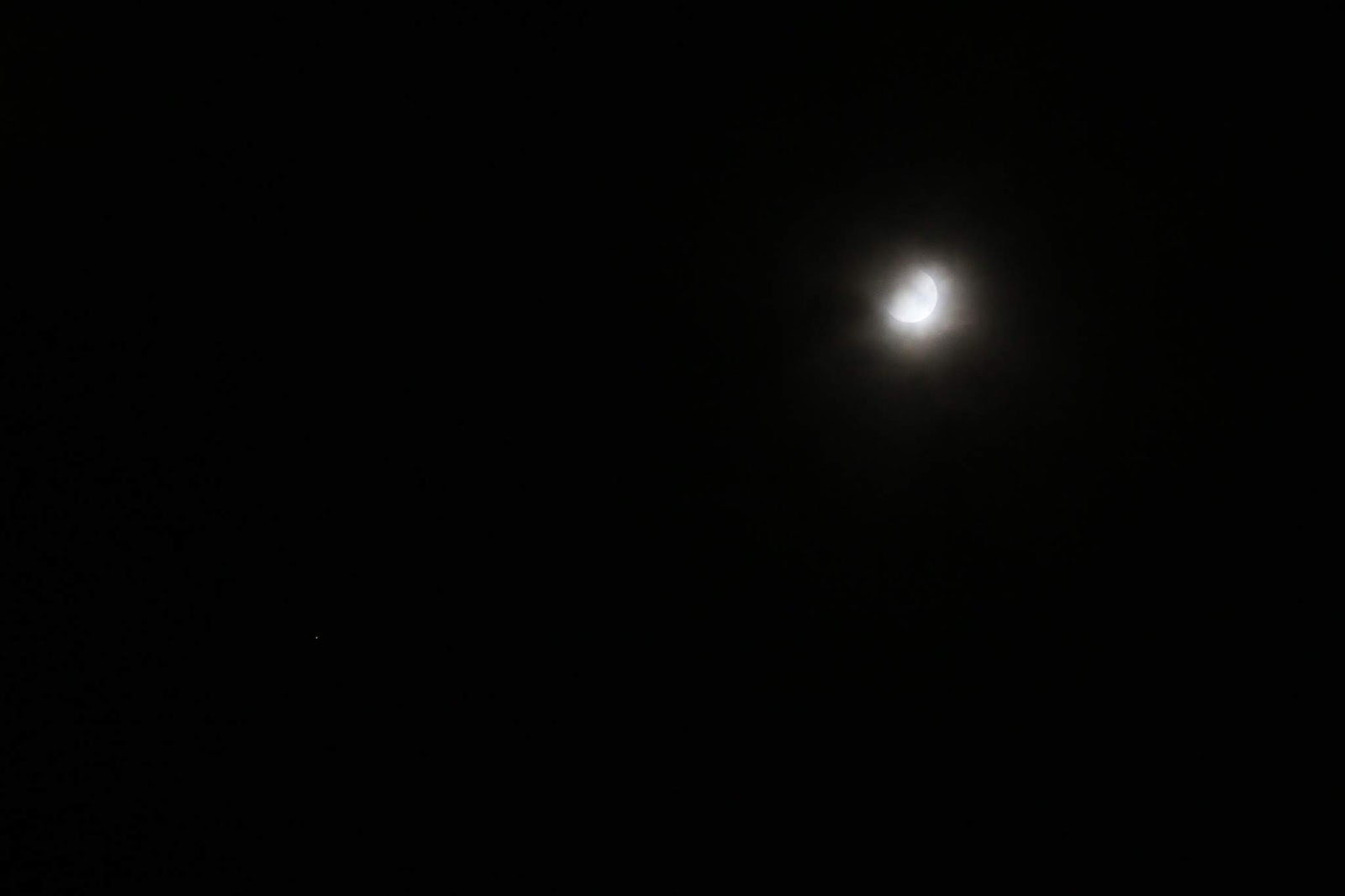
Since the mount was occupied, I took this with a Canon 100-400mm hand-held using spot metering, 0246 (GMT+8):
And then a wide field shot, 0248 (GMT+8):
Manual exposure was used to keep the exposure fast enough not to overexpose the lunar disc too much.
And then this one at 0318 (GMT+8):-
And a quick closer up 0323 (GMT+8), to show the red hue:-
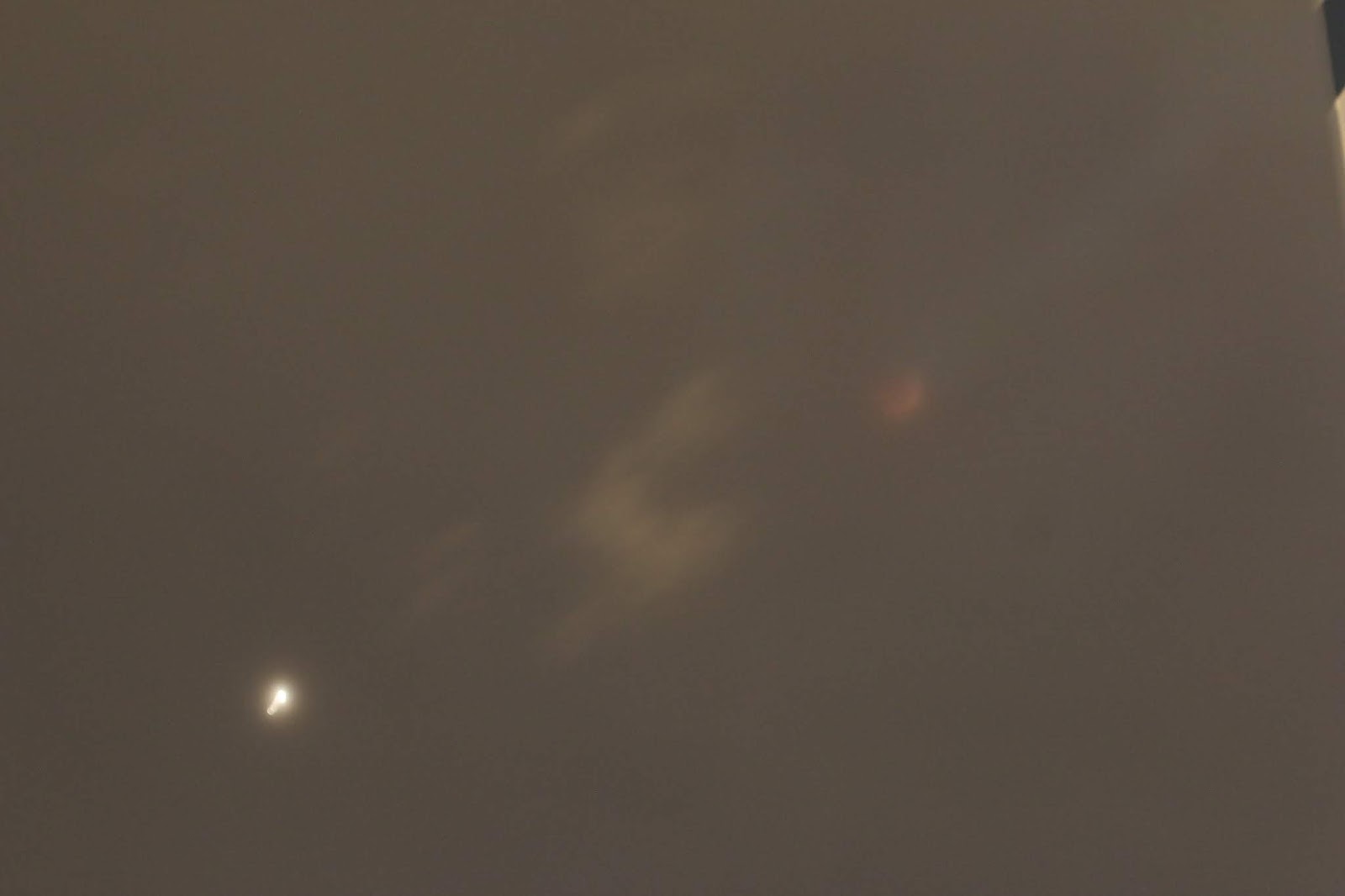
And then things got worse, I have to use GOTO to the moon! Can you see the moon in this shot? I am sure not! The shot below also told you how close the moon to a nearby new building.
But you know, when there's nothing, there's really nothing there! I pulled out my 10x30 and checked with my eyes, nothing. 5 seconds exposure? nothing.
When you were about the give up, I realized that I could just close the window and sit in an air conditioned room to wait, so why not? After some wait and hey... was it a cloud or what? no, it's the moon! taken at 0409 (GMT+8)
The Mars was way brighter than the moon by then, not unexpected, right?
04:22 (GMT+8), probably the best eclipse shot of the night, stars could be seen around the moon, clearest moment of the night. I could imagine such a totality would be wonderful under a dark cloudless night! But hey, we could only imagine as a Hong Kong observer!
04:25 (GMT+8), and the Canon 100-400mm got the mount now, I checked the EXIF and it was at 200mm, a zoom lens could be nice for this purpose, you could frame your shot the way you liked:-
And a shorter exposure one at 0426 (GMT+8):-
I tried to get a close up but it was shaky, since the cloud was getting thick resulting in longer exposure. The cloud window was closed.
Alright, time to sleep. Luckily, it was Saturday in the next morning so I could sleep longer to make up the observation time.
Finally, a few slash back shots:
First up were two mobile phone shots while going home, before the eclipse:
This shot with a historical building in the front, should be taken as layers and merged back, but I got no time to do so.
Equipment shots, of course, taken during cloud cover, just a record. The new ES diagonal is nice.
And finally, the Canon 100-400mm lens on the Nexstar:
Sorry that I (very rarely these years) bought new equipment these weeks, and still got some in transit, weather curse applied.
A short summary in Chinese: 香港天文,注定有雲 (Hong Kong astronomy, cloudy astronomy)