This article is originally at my website:
http://oldfield.sinaman.com/star/venus2004/venus2004.html
Preparations: I did some preparation before the transit.
Since it's a very rare event, so we really have to do some
planning, I told myself.
Visual observation is always my preference, photography is next.
However, I always want both, whenever possible. Therefore, I
plan to use my Giro mount twin arm, the C8 + binoviewer on one
side for viewing, and the Ranger + camera for photography at the
same time.
Binoviewing will give the best view to my EYES, while the Ranger
will give a wide enough field so that it can work itself without
too much attention during the process, at least Venus won't get
bumped out of the field easily.
The black drop effect is one of my biggest targets, but the duration
is rather long for the whole process (I don't know that before the
transit). Therefore, using a webcam to capture this event will take
up a lot of hard disk space, which is a little bit limited with my
small Sony Vaio U3 which got only 10G space left. Also, webcam
will yield a tiny field which makes the imaging harder, and require
far more user attention. Since I want to concentrate on visual
observation, so webcam will be less than ideal.
A digital camera would be a nice choice, but my DC is of low quality,
also I will need to keep pressing the shutter to capture, therefore,
seems like another suboptimal choice. So, finally, I plan to use my
DV using afocal coupling.
For the location, I plan to go to Long Ku Tan of Tuen Mun. At that
place, we can see the Sun sets on the sea if we're lucky, I mean if
there is no cloud. It would be a must for those who wish to try to
see the 3rd contact in Hong Kong, since it happens just within 5
minutes before the sunset.
Before the transit, I did some experiments with my equipments. I
did try to match my binoviewer reducer to my webcam to work with
my Ranger. The field is larger and it can reach focus, so it's
a good candidate to get some close up but yet still can see solar
limb shot. I did try also my C8 plus webcam, but the field is
too narrow so that outcome will be just a black circle on a white
background. With my C8 + 40mm afocal + DC, I will see the shadow
of the secondary at lowest zoom, but at medium zoom, it goes away
but it would be hard to keep the same zoom during all exposures
along the whole session, my DC is bad enough not to show the focal
length on screen.
Implementation: Things turn out to be way out of my expectation.
X(
First of all, I failed to buy the afocal adapter for my DV due to
my personal schedule, so I have to stick with my webcam and my DC.
This is not very bad indeed, since I had never tried DV afocal before,
and I never want to try new stuff in this situation.
Second, the weather was poor, very poor in the morning of 8th of
June. I actually gave up to travel to the site which I originally
planned. I went to a playground near my home instead, so that my
2 years old daughter can share the view, and also my wife can.
This was not a bad choice at all to me.
Third, it was the worst decision ever in this event. I gave up
getting out my Giro + C8 + Ranger combination which I originally
planned for. Instead, I just got my Ranger out. This forced me
to either shoot or see. (actually not, I later realized, I can
visually observe, switch to a camera occasionally)
The Process: I arrived the playground around 1:00p.
Actually, I was tempted to stay inside my home to shoot, but
luckily that I didn't do so, or else I would miss the great
moment.
On arrival, I saw a lot of primary school students around.
Of course, they knew it was Venus transit from the news and
it attracted a lot of them to see. I always want to share
the view of the great moment with people, so I decided to
put my DC on so that they can see it on the screen, instead
of queuing up one by one to see in the eyepiece. Later I
found it was a bad choice for myself despite it's the best
choice for the public.
Setting up the stuff took me 5 minutes, rough polar alignment
with compass, level the tripod. While setting up the stuff,
the sun was fully covered by cloud, I could only barely make
it out where it was in the sky. After setting up the scope
for awhile, the cloud got thinner so that I could point my
scope to it easily, thanks to the wide field of the Ranger.
The cloud was thick enough so that the shadow minimization
method will not work.
The students were excited to see the sun on the LCD of my DC.
Some naughty boys began to cover my scope with their hands
and I warned them and then they cooperated later. It was
dangerous to observe here, since one sudden visitor could
come and remove my filter while I was observing. So, I was
somehow forced to use my DC to capture image, to share the
view, instead of using eyepiece. By concentrating on the
eyepiece, it would be hard to keep telling those students
not to touch the scope or to kick off the filter. Killing
my DC was not a problem since I always wanted to replace
it anyway, but killing my eyes would be less fun.
So, I adjusted the zoom so that the whole solar disc could
be seen while keeping it reasonably large so that finer
detail could be seen. There was no big or obvious sunspots,
so focus was a little bit hard to be accurate. Seeing was
moderate to bad. Anyway, I had confidence about focusing
with my past experience. Time went on, and the students
mentioned that they need to go to afternoon school. Oh,
they couldn't wait and none of them could witness the
transit.
So, my wife and my daughter, plus a few passerbys were here
with me eventually. Cloud moved, sometimes thicker and
sometimes thinner, but still the image on the LCD of my
DC still show out nicely.
The 1st Contact: At around 13:13 (HKT GMT +8), I
could see a shadow on 2:00 location of the solar disc
as on my LCD (or 10:00 location with eyes + eclipse
viewer). Oh, it was Venus, I was very sure about
that. I was getting excited. Wait, wait and wait, I
realized that it was definitely Venus. I captured quite
a lot of shots. With my old DC, my 256M memory card can
store nearly 300 photographs, so I was fine to press the
shutter as many as I could. I refined the focus a little
bit during the process.
The polar alignment was proved to be off by quite a lot,
so that I needed to hand guide it and to re-center the
solar disc every 5-8 minutes or so. Not too bad.
The DC keeps on the focuser for the 1st and 2nd contact,
which was the biggest fault which I had made that day.
The next worse decision was that, I used the Thousand
Oaks glass filter instead of the self made Baader film
based one. The quality was not as good, but it should
be safer since it's more reliable, more securely held
on for that group of innocent students.
A few images soon after the 1st contact, noticed that
my images were laterally reversed, taken with my Casio
QV2800 + 40mm Plossl + Thousand Oaks filter + Ranger +
Orion Min-EQ on Gitzo G106:
An animation showing the moment around and soon after the
1st contact, and before the 2nd contact, you can see a lot
of cloud floating around:
Images were cropped and re-scaled to around the same size,
the raw images are of different image scales and are not
spaced equally in terms of time.
The 2nd Contact: Venus moved slower than I imagined,
or I was getting a bit impatient due to over-excitement.
Instead of keeping the camera on the focuser, I should
have removed it to have some observation with my eye on
the eyepiece. Too bad that I didn't do so.
As the Venus moved deeper into the solar disc, the picture
was getting more funny. Black drop effect could appear
every next minute, so I kept pressing the shutter in order
to maximize the chance to capture that moment.
Later, I found that people could capture the atmosphere
of the Venus if the exposure was extended a little bit.
Too bad that I didn't try it out, or better said, I didn't
realize that, insufficent research... oops... I was
told, if I observed with my eyes, I should realize that...
too bad that I kept my DC on the focuser throughout the
process.... what a shame!
During the process of waiting, I tried out different
exposure setting, and I found out that over exposure
would yield a bit more funny result, please see:
Over exposure
vs. Automatic exposure (sorry for non matching image
scale)
So, I guessed that black drop effect would be more
obvious with over exposure. Anyway, let's see another
animation showing the moment around 2nd contact:
And a few more shots which show black drop effect
the best, not very good, but they were mine, the
2nd one is closer to the moment:
Black
drop effect, closer for the picture on the right It has been a bit of debate about the black drop effect.
People having hydrogen alpha filter tends to have it
captured, people with high quality instruments and white
light filter tends to miss it. So, it is still a
mystery for whether it is real, or it's just defects
on instrument. Some people eye witness that there were
none, but some said there was. I didn't see it myself,
since my focuser was occupied by my DC unfortunately.
To me, the nature of black drop effect is the fuzzy
moment, so who could well define such a fuzzy moment?
The moment after getting rid of the black drop, i.e.
around 2nd contact:
Finally, an image after the 2nd contact:
After the second contact, I planned to leave that park.
My DC was very hot, both by the sun and also after I
took that many images in this short period of time.
This was also the time which I realized that missing
the visual observation chance was the biggest fault.
After I replaced the camera with a 20mm Widescan III
eyepiece, the view was just superb! Venus was a very
well defined black disc, not just a tiny dot like the
last time for Mercury transit. Very nice view, I love
it very much but that was a bit too late. I shared
the view with my wife and also my 2 years old daughter,
they love it too. Venus appeared larger than we all
imagined.
We have a Thousand Oaks eclipse viewer so that we can
observe with naked eyes with it, we can clearly see
Venus, nice indeed. Hong Kong Astronomical Society
is wonderful enough to send this viewer as a gift to
all her members.
Then, I packed up all my stuff and went back home.
Since I could see the sun by that time, I could
also setup my C8 with binoviewer to observe there
as well. Also, playing with webcam was far easier
as well. So bad that I didn't spend time to boot
up my Vaio U3 for webcam capturing inside that
playground. It should be a better device. But
again, due to the environmental constraint, I dare
not to put my webcam into risk. So bad. The
playground was not a nice place at all.
The Long Transit: Venus travelled rather
slowly across the solar disc, and cloud moved in
and out during the process. At home, I could
have access of all equipments. I did played with
the following combinations:
- C8 + 40mm Pentax SMC XL: full solar disc
can be seen, high constrast, very nice indeed!
- C8 + 0.5x reducer + binoviewer + 20mm Widescan III:
absolutely the best view, highest contrast, 3D
effect on the black Venus disc, full solar disc can
be seen, this view makes me regret about not bring
out the dual scope setup
- C8 + webcam: dull, a black disc on a blue surface,
could barely reach the limb
- C8 + webcam + 0.5x reducer: a little bit better than
without the reducer, but still no one would want it unless
during the contacts
- C8 + 40mm plossl + DC: at widest zoom, could see
the shadow of secondary, not very good, not preferred,
could barely make out the full disc, but no good.
- Ranger + 20mm Widescan III: nice wide view.
- Ranger + webcam: not bad indeed, could see the solar
limb, and at the same time keeping the Venus nicely in
the view
- Ranger + webcam + 0.5x reducer: even better, could
see more solar limb, but barely reach focus, nearly all
the way in for both the drawtube and the helical focuser.
- Ranger + 40mm plossl + DC: not bad.
To me, I found missing the dual scope setup during the
1st and 2nd contact was a pity, but at the same time, I
love to change the venue of observation so that my daughter
and my wife could share the view. I tend to put family
into my first priority, so it makes sense. Of course,
it could have been better if I bring the dual scope setup
to the playground. Anyway.
Taking inside my
home
There're some images captured with webcam, please see
below:
This is taken with
my C8 + ToUCam at prime focus, Baader solar film, image scale
is so large that it becomes a boring dark ball.
This is taken with my
Ranger + ToUCam + binoview reducer + baader solar film, image
scale is large but this time can see some solar limb. Notice
that the first frame and the last frame are separated by 8
minutes only, from 1550-1558 (HKT), the middle frame is sharper
and can see a sunspot.
This is taken with my
Ranger + digital camera + baader solar film, from 1600-1618 (HKT).
Somehow it's boring to wait inside home, also, the view
was very limited inside my home so that I believe well
before 5:30p, the sun would be blocked by the buildings
nearby. So, my mind swinged back to go to the original
site which I had planned for my observation, to catch
the last few minutes for Hong Kong observers.
Catching the Last Minutes:
The sky was covered at around 4:00p, so it strengthened
my desire to go. Finally, I left home at around 4:50p.
I went there by the new railway (KCR west rail) and
I reached the Nam Cheong station at around 5:05p, arrived
Tuen Mun terminal at 5:30p and missed the K52 bus toward
my destinations. Got on the next bus on 5:48p and arrived
the beach at around 6:30p, still 30 minutes more for the
last minutes.
To do a little bit math, I gave up 1.5 hours to get 30
minutes. To add a few more adjective, I traded 1.5 hours
boring or even maybe cloudy view, with around 30 exciting
minutes which possible to include the 3rd contact which
was barely possible for Hong Kong!
With me, I have the setup which was with me earlier the
same afternoon in the playground. Like the last time, I
didn't setup my notebook. On placing the sun into the
view, I saw nothing, oh no, there was a hint of the sun
behind the thick atmosphere plus the solar filter. I saw
someone around me who shifted the filter a little bit to
gain more light, i.e. partially covered. I didn't think
that it's safe to go this way. Also, my mounted filter
didn't allow me to do so.
Quite a lot of
telescopes and cameras
There was a group of students, several observation buddies
already there. From 10" SCT to 3" Newtonian, and my 2.7"
refractor, and some camera lens, there were a wide variety
of equipments there.
Please see below another animation taken soon after my
arrival of the site:
Taken with my Ranger
and my digital camera without any filter, don't ever try it
yourself, it's too dangerous.
Ranger waiting for 3rd
contact, see what's wrong in the photograph?!
A photograph of me
taken by my friend
Notice that it was foggy on the sunset direction, so how
long could the sun survive through this thick atmosphere?
Only time could tell.
An exercise for the reader who is patient enough to read
to this point. Guess why the camera was mounted with the
diagonal pointing downward? Hint: look at the position
of the counter weight on its shaft.
Right! You got it. I ran out of counter weight. By
pointing the additional stuff downward, the torque is
reduced, so that the counter weight will be enough. Nice?
haha... anyway, it would reduce the requirement on counter
weight, a pretty nice trick to me.
Also see what's wrong with my EQ mount setting... idiot
I was.
The transit gave me a leisure moment in the middle of
a working week, not bad indeed. I didn't mind to travel
a bit on public transportation, it was relaxing anyway,
despite of the a little bit heavy equipments. The most
important thing is fun!
Take a look at this filterless photograph, don't even
try it yourself. I did it because I didn't mind to kill
my camera. Centering the sun was also done with camera,
not my eyes to avoid any risk.
Ranger + 40mm afocal,
no filter
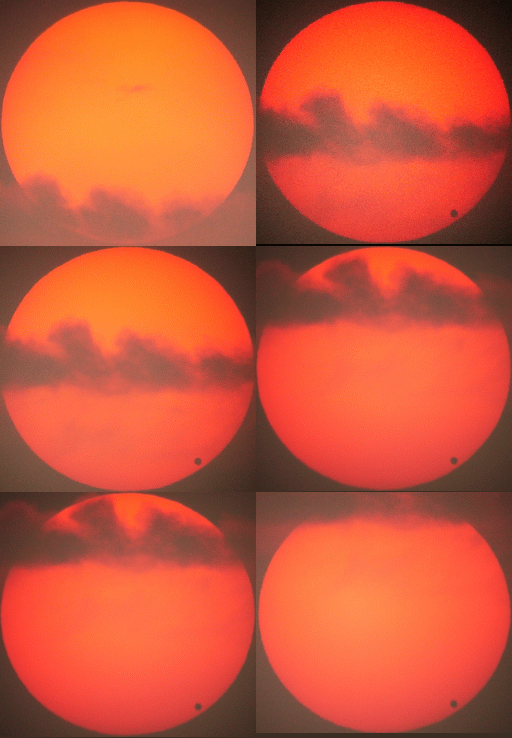
A large piece of cloud was coming, see whether it would
kill the setting sun!
A dragon shaped cloud!
The Sun has survived another challenge!
But another bad challenger came! Looked very much
like that the sun was landing on dust, right?
See the animation with another set of cloud:
Centered using the Sun, so
you see the cloud patch is running upward, but in reality, it's the Sun
to sink to get rid of the cloud.
The sun made it, yeah! But finally, it has to come to an
end. Here are the last few shots:
Cloud is getting thicker
So that the Sun did not survive too much zoom
Zoom out a bit to catch a few more minutes
Can you still make out Venus on this image?
Looked like the Sun is descending on the dust/cloud? Funny
view! Right?
But this one, no more
Venus, totally blocked
Exciting moment has passed, let's sit back and enjoy the
nice setting sun which is still marginally noticeable.
Very thick atmosphere
at up to a few degrees has blocked the view to the 3rd
contact
As you would know, I missed the third contact, however,
it was close. Close enough that I would say that I enjoyed
completely. I packed up the thing quickly and caught the
bus to back home. Arriving home well before 9:00p and found
that my Baader filter was broken during the trip, anyway, it
just costs a few dollars but it brings enough joy to me
already.
Concluding remarks:
Got to summarize what I have learnt during the event:
- Good planning is a must, and several plans should
be derived to handle different situation.
- Never gave up any plan without a good reason. I
lost my dual scope setup plan due to the weather, and
failed to have another good backup plan.
- Visual observation is my first priority, photography
is next. Also, critical moment could sometimes be long,
so by all means observe, and if the view was good, go to
take photographs then.
- Avoid crowdy locations, especially with too many
children, especially for the observation of the sun,
which could be dangerous. Publicity and promotion could
be done separately.
- Conduct a little bit more research, while nearly all
the people tried to capture the black drop but some wise
guys captured the atmosphere of Venus between 1st and
2nd contact.
- Prepare all the equipments planned to use, don't make
urgent purchase.
Going from one place to another for the same event is rare,
chasing a transit could be fun, I would say for this event.
I went to another place to look for a longer observable
transit, and also to avoid the local bad weather. However,
moving across places will also miss some important records
within the event, as you could see that I have no photographs
taken between around 5:00-6:30p HKT.
Last but not least, by all means enjoy. I enjoyed fully
this time.